
| 1. A turbine with 4 blades made from 5 l plastic bottle, diameter of the bottle 135mm | 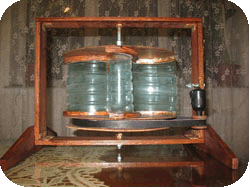 |
| 2. A turbine with blades made from 3 l plastic bottle, diameter of the bottle 95mm | 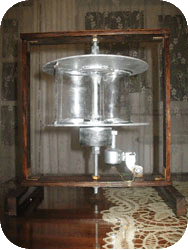 |
| 3. A turbine with blades made from 2.5 l plastic bottle, diameter of the bottle 82,5mm | 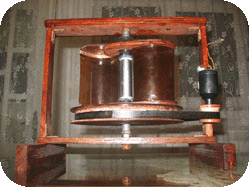 |
| 4. A turbine with blades made of PVC pipe of 100mm diameter | 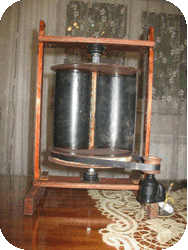 |
| 5. A turbine with 2 vertical blade steps made of PVC pipe of 110mm diameter | 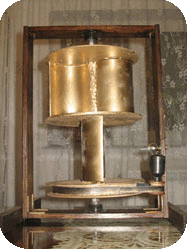 |
| Characteristics | 1 | 2 | 3 | 4 | 5 | Wind speed needed | 1 | 5 | 4 | 4 | 2 | Technical aspects | 2 | 5 | 4 | 3 | 1 | Energy produced | 1 | 4 | 5 | 3 | 2 | Costs | 3 | 2 | 1 | 4 | 5 |
| Turbine | 1 | 2 | 3 | 4 | 5 |
| Observations | Fixed axel, mobile bearing Dynamo entrained by fixed axel |
Fixed axel, mobile bearing Dynamo with direct contact on the turbine’s frame |
Fixed axel, mobile bearing Dynamo entrained by fixed axel |
Blades surface is larger, mobile axel, fixed bearing Dynamo entrained by mobile axel |
Blades placed at 90° angle Dynamo entrained by fixed axel |
| The cost of each turbine (euro/$) | 7euro | 6.5euro | 5euro | 7.5euro | 8euro |
In order to research the meteorological conditions, we register the wind speed by using an anemometer and direction and the air temperature for almost one year.
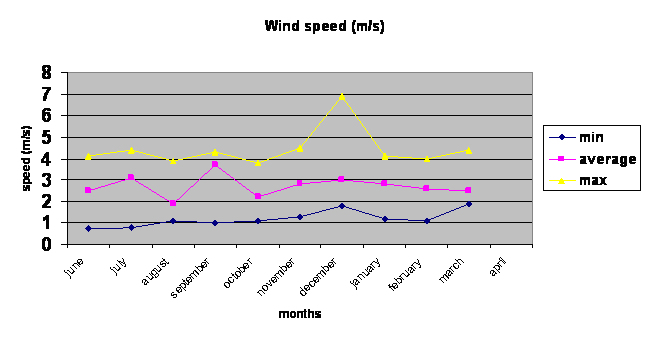
| Month | Min | Average | Max |
| June | 0,75 | 2,5 | 4,1 |
| July | 0,8 | 3,1 | 4,4 |
| August | 1,1 | 1,9 | 3,9 |
| September | 1 | 3,7 | 4,3 |
| Octomber | 1,1 | 2,2 | 3,8 |
| November | 1,3 | 2,8 | 4,5 |
| December | 1,8 | 3 | 6,9 |
| January | 1,2 | 2,8 | 4,1 |
| February | 1,1 | 2,6 | 4,0 |
| March | 1,9 | 2,5 | 4,4 |
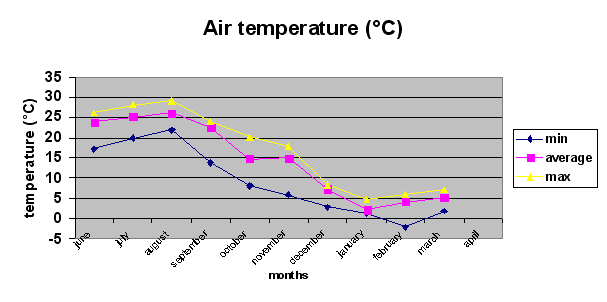
| Month | Min | Average | Max |
| June | 17,3 | 23,9 | 26,2 |
| July | 19,9 | 25,1 | 28 |
| August | 21,9 | 26,1 | 29,2 |
| September | 13,9 | 22,5 | 24 |
| Octomber | 8,1 | 14,8 | 20,1 |
| November | 5,9 | 14,9 | 17,8 |
| December | 2,8 | 7,3 | 8,4 |
| January | 2,8 | 7,3 | 8,4 |
| February | -2,1 | 4,2 | 6,0 |
| March | 1,9 | 5,2 | 7,1 |
• It is more environmental friendly in confront with the other 5 models (ALL the materials are taking from wood, plastic and electrical devices waste)
• It is the most effective (it produce the larger amount of energy and can switch on the major number of LED) – we register 1, 23 J
• We don’t have to use a dynamo to convert mechanical energy into electricity
• It is the less expensive (less than 1 EUR for the nails)
• Can be use for small devices (single light bulbs or small number of LED)
• Can be put in a series for a bigger amount of energy
• Can be placed nearby the windows